If you are planning skin treatments in Seoul, you have probably found two kinds of answers about the medical tax refund. Some pages say it was abolished on January 1, 2026. Others, including a tax news site that still ranks near the top of Google, say it was extended to the end of 2026.
Both cannot be true, and the easiest way to settle it is to read the law itself. This guide does not rely on blogs or agency pages. We opened the Korean statute on the Korea Ministry of Government Legislation's database (law.go.kr), including a version that has already been published but only takes effect in 2027, and we took screenshots so you can see the wording yourself.
The short answer
| Question | Answer (as of September 14, 2026) |
|---|---|
| Can foreign visitors get the VAT back on cosmetic treatments done in 2026? | No |
| What deadline does the law set? | Treatments supplied by December 31, 2025 |
| Was it extended to 2026? | No. A bill proposed that in 2025, but it never became law |
| Is anything pending now? | Yes. Two amendment bills filed in 2026 would bring it back. Neither has passed |
| Is tax-free shopping affected? | No. That runs under separate rules |
The rest of this page shows where each answer comes from.
What the statute actually says
The refund was created by Article 107-3 of Korea's Restriction of Special Taxation Act. The article's title translates as "Special case for VAT refunds on cosmetic medical services for foreign tourists."
Paragraph 1 says that a foreign tourist who receives qualifying medical services at a medical institution registered under the foreign-patient law "by December 31, 2025" may receive a refund of the VAT on those services.
Two details in that sentence matter more than most articles admit.
First, the cut-off is about when the treatment was supplied, not when you file. A procedure on January 2, 2026 never qualified, whatever the paperwork says.
Second, paragraph 3 gives patients three months from the date of the service to submit the medical service supply certificate to a refund operator. So even for a treatment on the very last day, December 31, 2025, the filing window closed at the end of March 2026. There is no late route left.
Korean law has a useful feature: amended versions that have been passed but are not yet in force are already published. So we did not stop at the current text. We opened the version of the Act that takes effect on June 17, 2027.

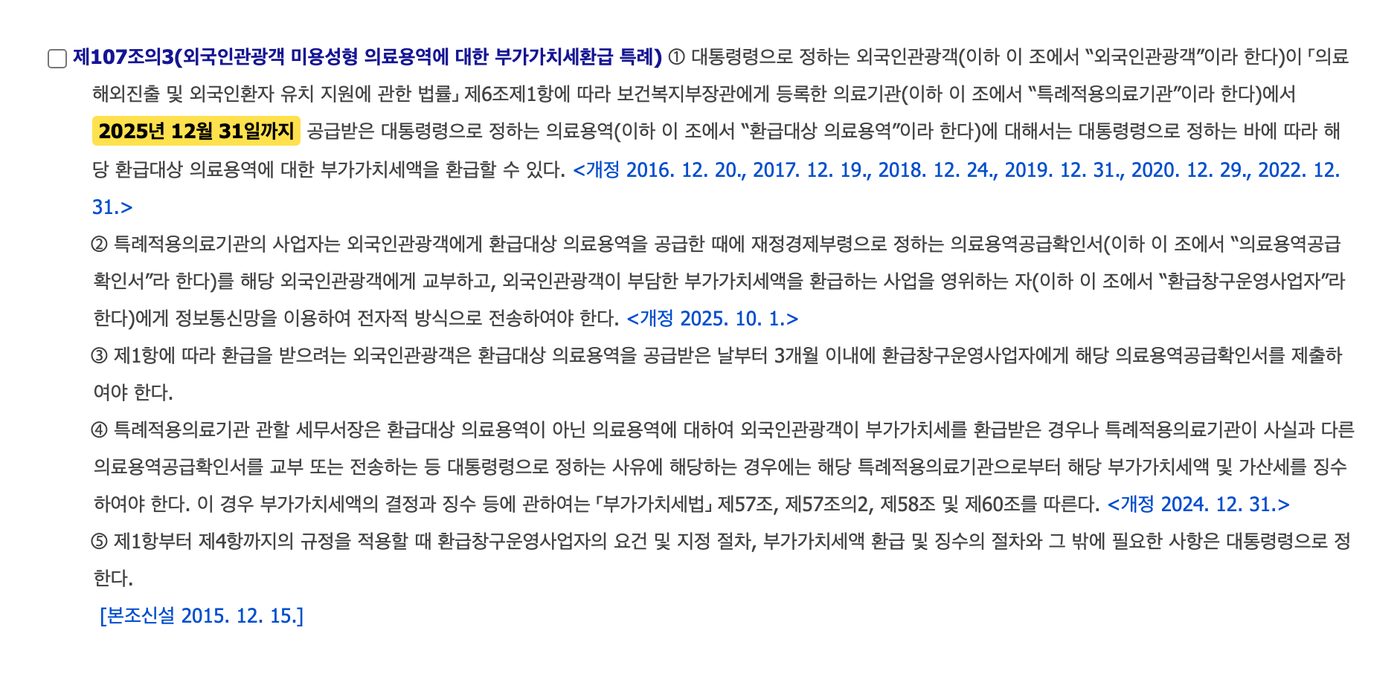
The highlighted phrase, 2025년 12월 31일까지, means "by December 31, 2025." We checked three versions in total: the version in force, a version effective September 18, 2026, and the June 17, 2027 version above. All three carry the same date. As of today there is no extension written into any published version of the law.
"But I read it was extended to 2026"
This claim comes from a real bill, which is why it keeps spreading.
On August 22, 2025, bill No. 2212306 was filed in the National Assembly. It proposed moving the deadline from December 31, 2025 to December 31, 2026. English-language tax news reported it under headlines saying the refund had been extended.
A bill is only a proposal. The extension never made it into the law. The version in force and every later version we checked still say December 31, 2025, and refunds stopped for treatments from January 1, 2026. If a page tells you the refund runs through 2026, check its date. It is almost certainly describing that 2025 bill.
What is pending in 2026
The debate did not end with the expiry. According to Korean press reports we reviewed on September 14, 2026:
- A bill filed in April 2026 would extend the special case to December 31, 2027. It was referred to the relevant National Assembly subcommittee for review on July 29, 2026.
- A second bill, filed on August 13, 2026, would restore it through December 31, 2029.
Neither has been passed. If one does pass, three things will decide whether it helps your trip:
- The effective date. Korean tax amendments usually apply to services supplied after a set date. Do not assume a new law would reach back to treatments you already had.
- The deadline and scope written into the new text.
- Whether your clinic is registered, which was always a condition (more on that below).
We will update this page when the statute changes. Until the new wording appears on law.go.kr, plan your budget as if there is no refund.
Why "not extended" is more accurate than "abolished"
Look again at the end of paragraph 1 in the screenshot. The bracket lists the dates on which this article was amended.
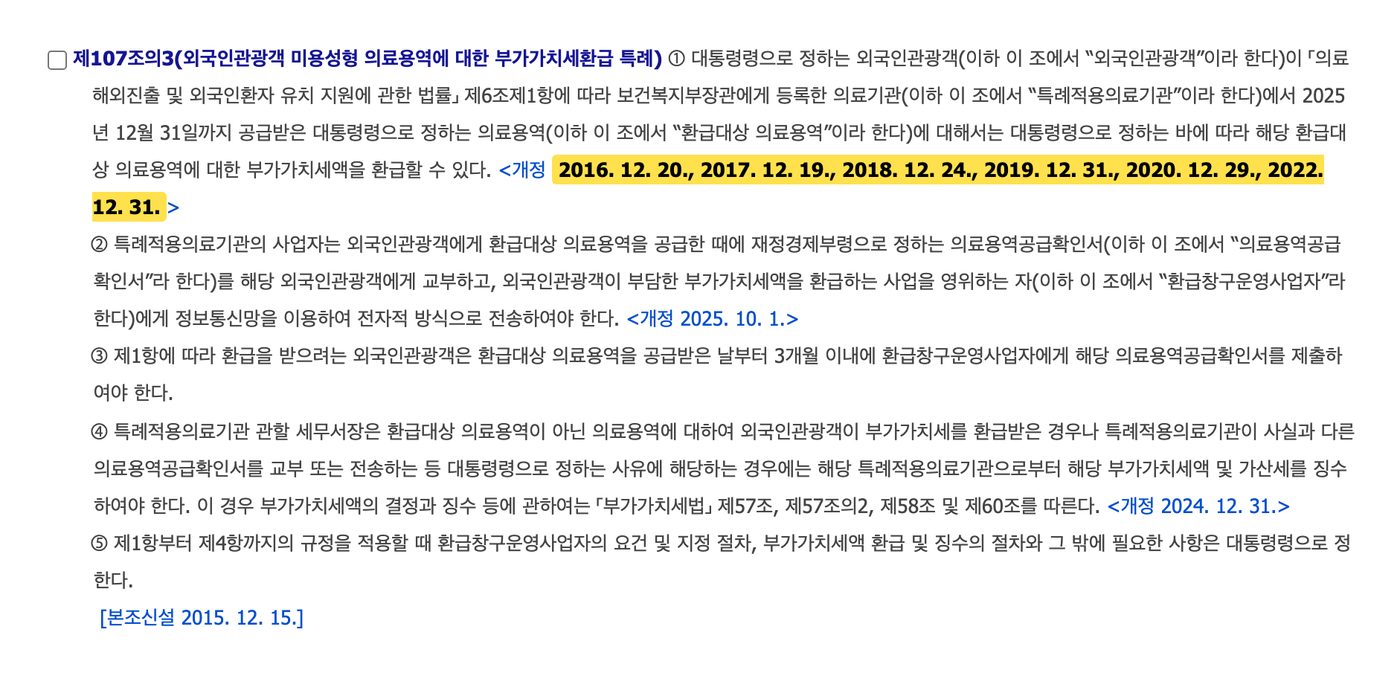
The program began as a one-year pilot. The Ministry of Health and Welfare's announcement in March 2016 described a refund for services from April 1, 2016 to March 31, 2017, available only at registered clinics (1,522 institutions at the time). After that it was renewed again and again, with amendment dates in 2016, 2017, 2018, 2019, 2020 and 2022.
The article is still in the Act. What ran out is its date. That is why some Korean coverage describes the end as an "expiry" (일몰, a sunset clause), and why reinstating it only takes an amendment to that date. It is also why you should not treat any rumor as fact until the text changes.
Which treatments carried VAT in the first place
A refund only makes sense where tax was charged. In Korea, medical care for treatment purposes is exempt from VAT. The 10% tax applies to procedures the law classifies as cosmetic, and the Enforcement Decree of the Value-Added Tax Act lists them by name.

The highlighted list reads, in English:
- Treatment of pigmented nevi, freckles, lentigines and melasma
- Acne treatment
- Hair removal
- Hair-loss treatment and hair transplants
- Tattooing and tattoo removal, and piercing
- Fat dissolving (lipolysis)
- Skin regeneration
- Skin whitening (brightening)
- Anti-aging treatment
- Pore reduction
A separate item in the same article lists surgical procedures such as double-eyelid surgery, rhinoplasty and facial contouring. Taken together, these lists cover most of the skin treatments international visitors book in Seoul: laser toning for pigmentation, acne and scar programs, pore treatments and anti-aging procedures. That is why the refund's end is felt most in "skin care" itineraries.
The same decree explains why some bills never showed VAT at all: treatment performed for medical reasons is exempt, so there was never anything to refund.
Only registered clinics could issue the refund certificate
This condition surprised many visitors who did not receive a refund even before 2026. Article 107-3 only applied to services at medical institutions registered under Article 6(1) of the Act on Support for Overseas Expansion of Medical Services and Attraction of Foreign Patients. An unregistered clinic could not issue the certificate, however eligible the procedure.
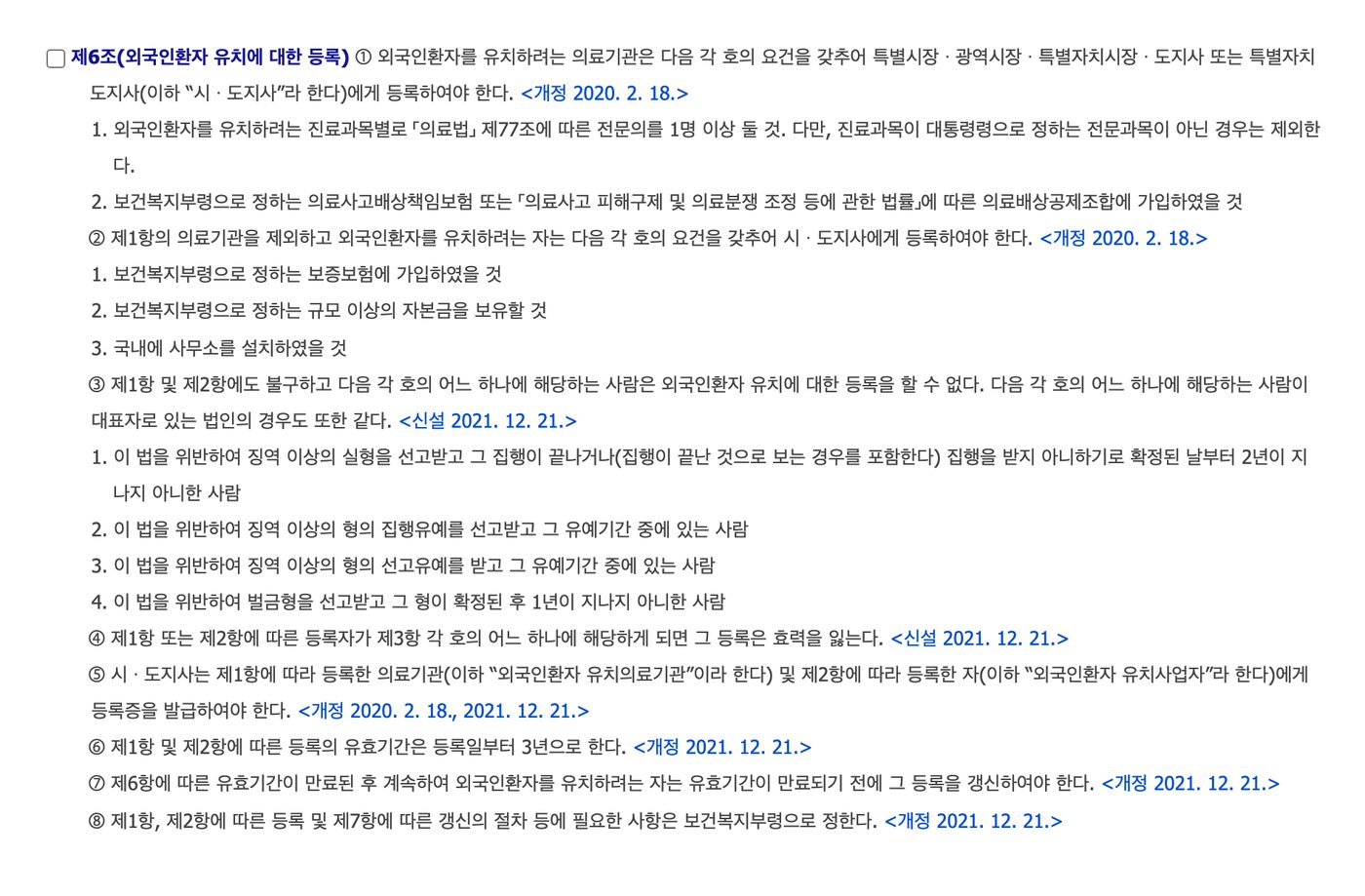
Registration still exists and still matters, even without the refund. It tells you two things about a clinic: it has formally registered to treat foreign patients, and it carries liability coverage. Under the Act's enforcement rule, that coverage must have an annual limit of at least ₩100 million for clinic-level institutions. Korea's Medical Korea service publishes a free lookup of registered providers.
Why clinics were strict with the paperwork
If you claimed the refund before 2026, you may remember clinics checking passports, entry dates and procedure codes carefully. They had a reason.
Paragraph 4 of Article 107-3 makes the clinic pay back the VAT, plus penalty tax, if a tourist received a refund for a non-qualifying service or if the clinic issued a certificate that did not match the facts. The enforcement decree spells out those cases.
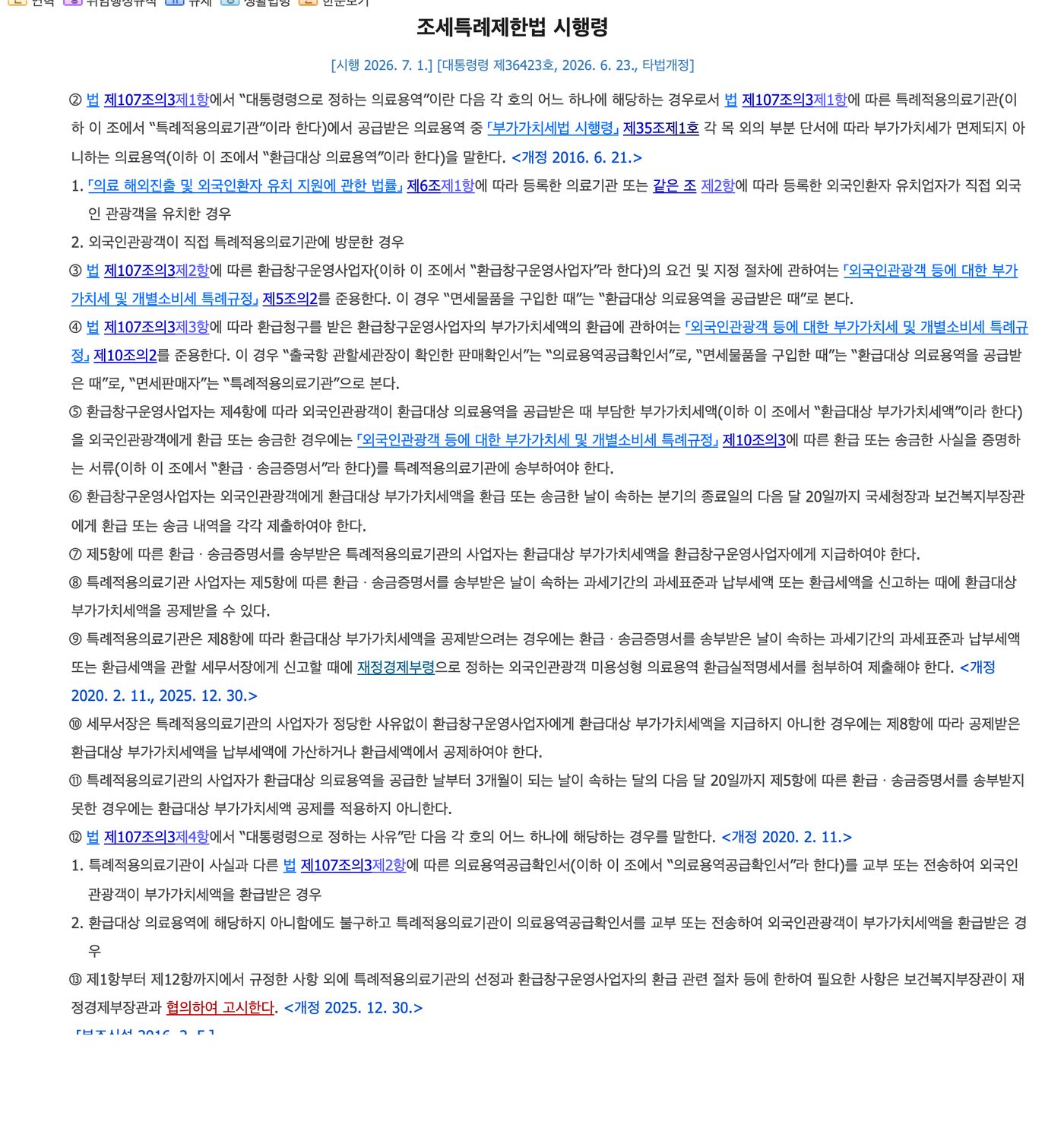
The risk sat with the clinic, not the patient, which is why clinics were cautious. These provisions remain in the text but have no practical effect while the deadline has passed.
When a clinic says "tax refund included"
In 2026 you will still see clinic and booking-platform promotions that use the words "tax refund," "VAT back" or "10% cashback." Treat these as discounts, not as the government program.
| Government VAT refund (ended) | Clinic or platform promotion | |
|---|---|---|
| Legal basis | Article 107-3 of the Restriction of Special Taxation Act | The business's own terms |
| Where the money comes from | Refunded tax | The business's marketing budget |
| Proof | Medical service supply certificate sent to a refund operator | Whatever the business issues |
| Can it change overnight? | Only by amending the law | Yes |
A discount is still a discount, and there is nothing wrong with taking one. The point is to compare it as a price, not to budget on the assumption that the state will return money later. A simple question clears it up: "Is this the government VAT refund, or your own discount?"
Tax-free shopping is not affected
The shopping refund for foreign visitors works under a separate regulation for goods bought at participating stores. The end of the medical special case did not change it. Cosmetics, clothing and souvenirs bought at tax-free or tax-refund stores are handled as before. The two programs used to share airport counters, which is why they are often confused.
How to budget now
Without the refund, one question has become more important: is the price you were quoted before or after VAT?
Many clinic price lists show amounts before tax. Here is purely illustrative arithmetic for a procedure priced at ₩2,000,000 before VAT:
| Before tax | VAT (10%) | You pay | |
|---|---|---|---|
| Treatment supplied in 2025 | ₩2,000,000 | ₩200,000 | ₩2,200,000, part of the VAT could be reclaimed |
| Treatment supplied in 2026 | ₩2,000,000 | ₩200,000 | ₩2,200,000, nothing to reclaim |
Under the old program, claims were processed by private refund operators designated under the enforcement decree, so we do not quote a "net refund" figure here. The practical advice for 2026 is simpler: ask for the final amount including VAT, and compare clinics on that number.
Korea's Medical Service Act also works in your favor here. Article 45 says a clinic may not charge more than the non-covered fees it has posted or notified, so it is reasonable to ask for the posted price before treatment.
Frequently asked questions
Q. Can I get a VAT refund on cosmetic treatments in Korea in 2026?
No. Article 107-3 of the Restriction of Special Taxation Act covers services supplied by December 31, 2025. The version in force and the published versions effective September 18, 2026 and June 17, 2027 all keep that date. Unless a new amendment is passed and takes effect, treatments in 2026 do not qualify.
Q. Was the refund extended to December 31, 2026?
No. Bill No. 2212306, filed on August 22, 2025, proposed that extension, but it was not enacted. Pages that say the refund runs through 2026 are usually reporting that bill.
Q. I had a treatment in December 2025. Can I still file?
Not any more. Paragraph 3 of Article 107-3 requires the certificate to be submitted within three months of the date the service was supplied. For treatments at the end of December 2025, that window closed at the end of March 2026.
Q. Are there plans to bring it back?
Bills filed in April 2026 (proposing December 31, 2027) and August 13, 2026 (proposing December 31, 2029) are pending in the National Assembly. Neither had passed when we checked on September 14, 2026. We will update this page if the law changes.
Q. My clinic advertises a "tax refund." Is that a scam?
Not necessarily, but it is not the government refund. It is usually the clinic's or platform's own discount. Ask whether it is the government VAT refund or their own promotion, and compare the final price including VAT.
Q. Does tax-free shopping still work in Korea?
Yes. The refund for goods bought by foreign visitors at participating stores runs under separate rules and was not affected by the end of the medical special case.
Sources we checked
Every statute on this page was read on law.go.kr, and the screenshots were captured from those pages:
- Restriction of Special Taxation Act, Article 107-3 (version effective June 2, 2026) and the version effective June 17, 2027
- Enforcement Decree of the Restriction of Special Taxation Act, Article 109-3 (version effective July 1, 2026)
- Enforcement Decree of the Value-Added Tax Act, Article 35 (version effective April 1, 2026)
- Act on Support for Overseas Expansion of Medical Services and Attraction of Foreign Patients, Article 6
- Ministry of Health and Welfare press release on the 2016 pilot (March 22, 2016)
For bill status, we relied on National Assembly bill records as reported by Korean media, and we checked the statute text directly. For how we research, see our method.