"Ghost surgery" describes something a patient cannot see happening. You meet a surgeon, you choose that surgeon, you are put under anesthesia, and someone else performs the operation. That person may be a different doctor, or someone with no medical license at all. You would not know, because you were unconscious.
If you are planning cosmetic surgery in Korea, this guide shows you the rules themselves rather than stories about them. We read Korea's Medical Service Act (의료법), its Enforcement Decree and its Enforcement Rule on the government's official legal database, law.go.kr, in the versions in force on September 14, 2026. We took screenshots of the key articles so you can see the Korean wording for yourself.
The short version: Korean law gives patients real tools, including the surgeon's name on a written consent form, a copy of that form, and CCTV recording of an operation on request. It also has clear limits, and some of them matter for non-surgical treatments such as injections and lasers.
This page explains what the statutes say. It is not legal or medical advice.
The short answer
| Question | What the law says (versions in force on September 14, 2026) |
|---|---|
| Does the Medical Service Act use the terms "ghost surgery" or "proxy surgery"? | No. Neither 유령수술 nor 대리수술 appears in any of its articles. Protection comes from several separate articles |
| Must the consent form name the surgeon? | Yes, for surgery, transfusion or general anesthesia that risks serious harm: the doctor who explains it and the principal doctors taking part (Article 24-2) |
| Must the clinic tell me if the surgeon changes? | Yes, in writing, with the reason (Article 24-2(4)) |
| Can I get a copy of my consent form? | Yes. The doctor may not refuse without a justifiable reason (Article 24-2(3)) |
| Will my operation be filmed? | Only if you or your guardian ask. Clinics that operate on unconscious patients must have CCTV in the operating room (Article 38-2) |
| Can I watch the footage afterwards? | Not just by asking. Only for investigations and courts, for the national mediation agency after proceedings start, or with the consent of everyone filmed (Article 38-2(5)) |
| Can a non-licensed person perform my procedure? | No. With narrow exceptions, only licensed medical personnel may perform medical acts, and having an unlicensed person perform them is also a crime (Articles 27 and 87-2) |
| Do these rules cover Botox, fillers and lasers? | Partly. The licensing, name-tag and record rules cover all medical acts. The written-consent and CCTV rules are tied to surgery, transfusion, general anesthesia, or operating on unconscious patients |
How Korean law approaches ghost surgery
The literal Korean for "ghost surgery" is 유령수술 (yuryeong susul). Official Korean documents, such as the amendment reasons quoted below, describe the problem as 대리수술 (daeri susul, "proxy surgery"). We searched the full article text of the Medical Service Act in force on September 14, 2026, and neither word appears in it.
That does not mean lawmakers ignored the issue. The official reasons published with two amendments name it directly. The reason for the 2021 amendment that created the operating-room CCTV rule, as provided by the Ministry of Government Legislation on law.go.kr, says that medical accidents happen during surgery, as do illegal acts such as "proxy surgery by unqualified persons" and sex crimes against anesthetized patients. Because operating rooms are strictly closed off, it says, objective evidence of malpractice or crime is hard to obtain. The reason for a 2025 amendment says its purpose was to strengthen criminal punishment of doctors who instigate proxy surgery by unqualified persons, and to improve patient safety in operating rooms.
Instead of one "ghost surgery" offense, the law works through five separate duties:
- Consent: tell the patient in writing who will operate (Article 24-2)
- CCTV: install cameras in operating rooms and film on request (Article 38-2)
- Licensing: only licensed medical personnel perform medical acts (Article 27)
- Name tags: people performing medical acts wear them (Article 4(5))
- Records: keep accurate, signed records and let patients see them (Articles 22 and 21)
The rest of this guide takes each duty in turn, with its limits.
Duty 1: the consent form must name the doctors (Article 24-2)
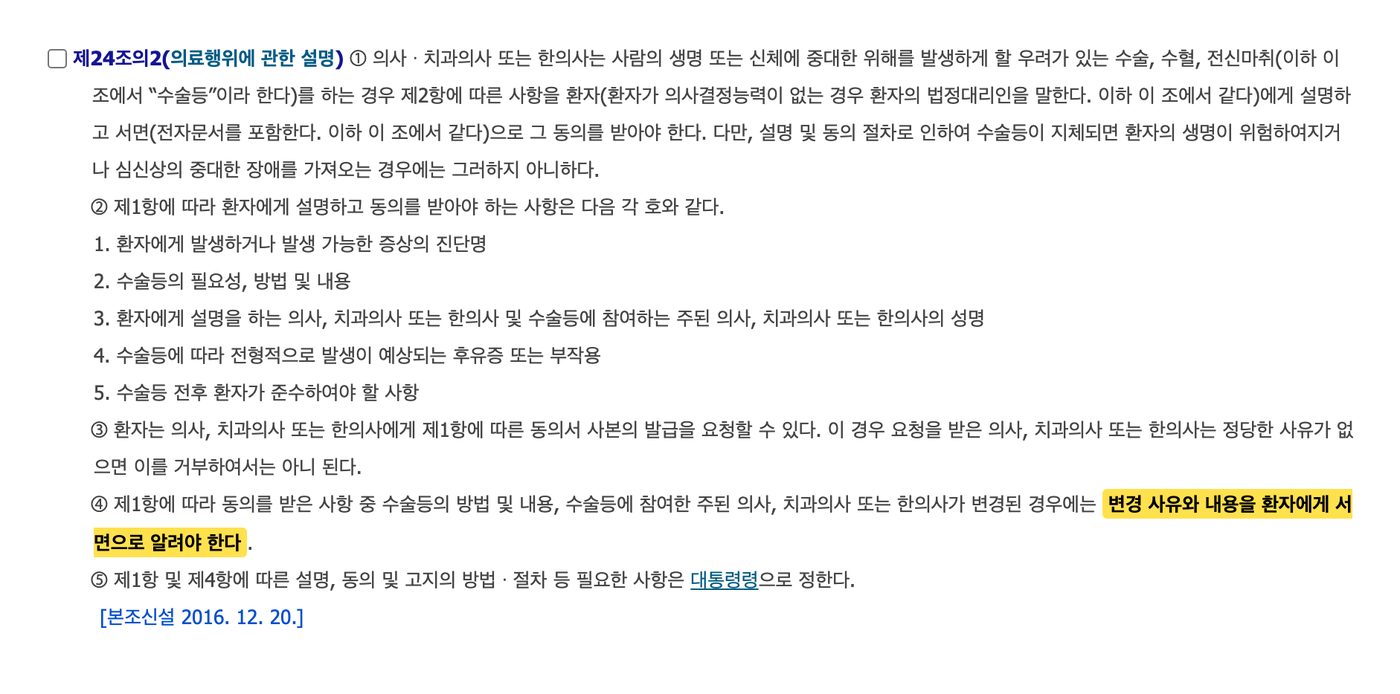
Article 24-2 applies when a doctor, dentist or Korean medicine doctor performs surgery, a blood transfusion or general anesthesia that is likely to cause serious harm to a person's life or body. In those cases the doctor must explain five things to the patient and obtain the patient's consent in writing (electronic documents count):
- The diagnosis of the symptoms the patient has or may develop
- Why the procedure is needed, and its method and content
- The name of the doctor giving the explanation, and the names of the principal doctors taking part in the procedure
- The after-effects or side effects typically expected
- What the patient must do before and after
Two further paragraphs matter most for ghost surgery:
- Paragraph 3: you may ask the doctor for a copy of the consent form, and the doctor must not refuse without a justifiable reason.
- Paragraph 4: if the method and content of the procedure, or the principal doctor taking part, changes, the reason for and content of the change must be given to you in writing.
The Enforcement Decree adds practical details. Its Article 10-13 says the consent form must carry the patient's signature or name and seal. Doctors must keep consent forms for two years from the date of consent, and written notices of change for two years from the date they were given.
The article has one exception: the explanation and consent steps do not apply if the delay they cause would endanger the patient's life or lead to a serious mental or physical disability. That is an emergency rule.
This screenshot was taken from the version of the Act effective April 7, 2026. We compared its wording with the version in force since September 11, 2026, and Article 24-2 is identical.
What happens if a clinic skips this
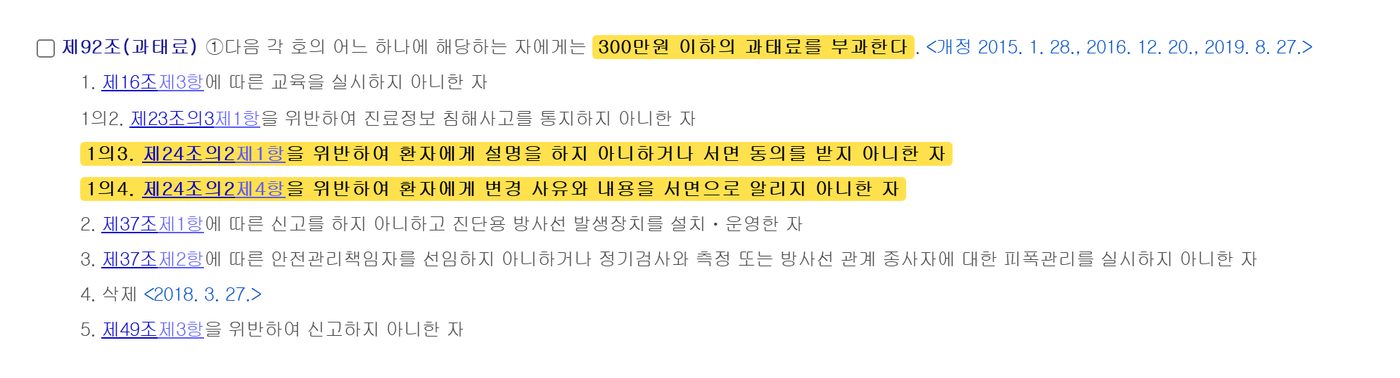
Article 92 sets an administrative fine of up to 3 million won for failing to explain or obtain written consent, and for failing to give written notice of a change. This is an administrative fine (과태료), not a criminal penalty.
In the penalty articles we read (Articles 87 to 92), we did not find a separate penalty attached to paragraph 3, the right to a copy of the consent form.
The limit: Article 24-2 does not cover every procedure
This is the most important caveat on this page. The written-consent duty is tied to surgery, transfusion or general anesthesia that is likely to cause serious harm. By its own wording, the article does not cover every cosmetic laser session, filler or Botox injection. Clinics may still ask you to sign a consent form for those treatments, but the statutory duty to name the principal doctors in a written consent comes from this article and is limited to its three categories.
Also note what the text leaves out:
- Paragraph 4 requires written notice of a change. Its wording does not say how far in advance the notice must come, and it does not mention consenting again.
- Neither the article nor the decree provision we read defines who counts as a "principal" doctor.
- Whether an undisclosed substitution also breaks other Korean laws, such as criminal or civil law, is outside what this article covers. A Korean lawyer can advise on a specific case.
Duty 2: CCTV in the operating room, filmed if you ask (Article 38-2)
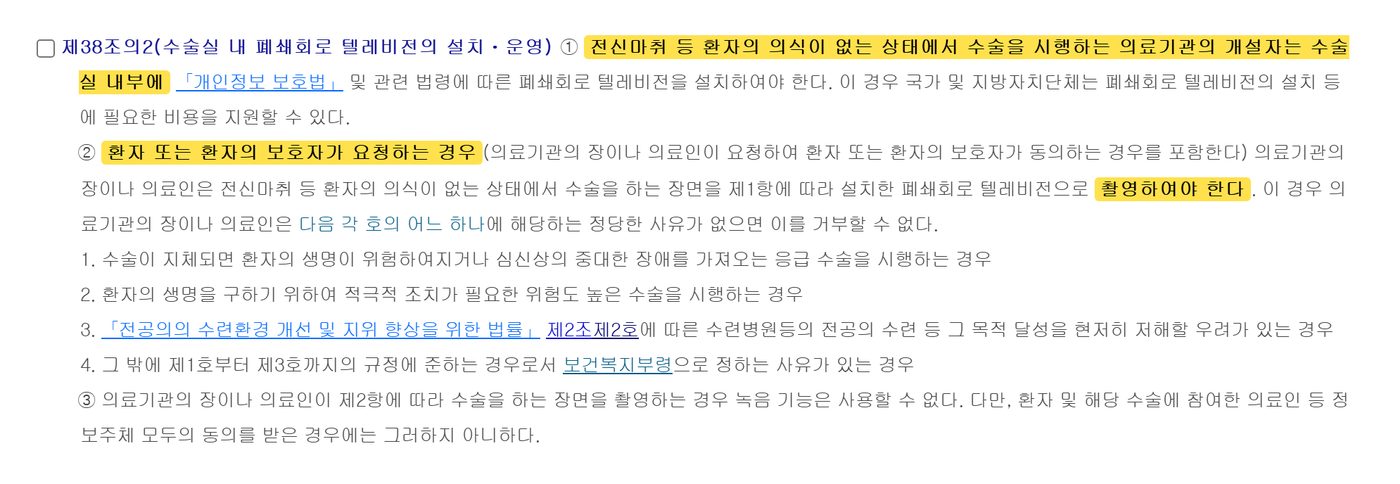
Article 38-2 is the rule aimed most directly at what happens while you are unconscious.
Who must install CCTV. Paragraph 1 applies to any medical institution that performs surgery while patients are unconscious, "such as under general anesthesia." The founder of that institution must install CCTV inside the operating room, following the Personal Information Protection Act. The text sets no size threshold. The duty follows the kind of surgery performed, not the type of institution.
When filming happens. Under paragraph 2, cameras do not film every operation. The clinic must film when the patient or the patient's guardian asks, or when the clinic asks and the patient or guardian agrees. A clinic may refuse only for listed reasons: emergency surgery where delay would endanger the patient's life, high-risk surgery that needs active life-saving measures, cases that would seriously hinder resident training at a training hospital, and similar reasons set by ministerial ordinance.
No sound by default. Paragraph 3 bans audio recording unless everyone filmed consents, including the patient and the medical staff taking part. The Enforcement Rule adds that if someone who has not consented joins the operation, for example as an emergency replacement, audio recording must stop (Article 39-13).
The screenshot's closing bracket (shown further down) records that this article was added on September 24, 2021, by Act No. 18468. That act's addendum says it took effect two years after promulgation, and law.go.kr lists that version as effective September 25, 2023.
How to ask for filming
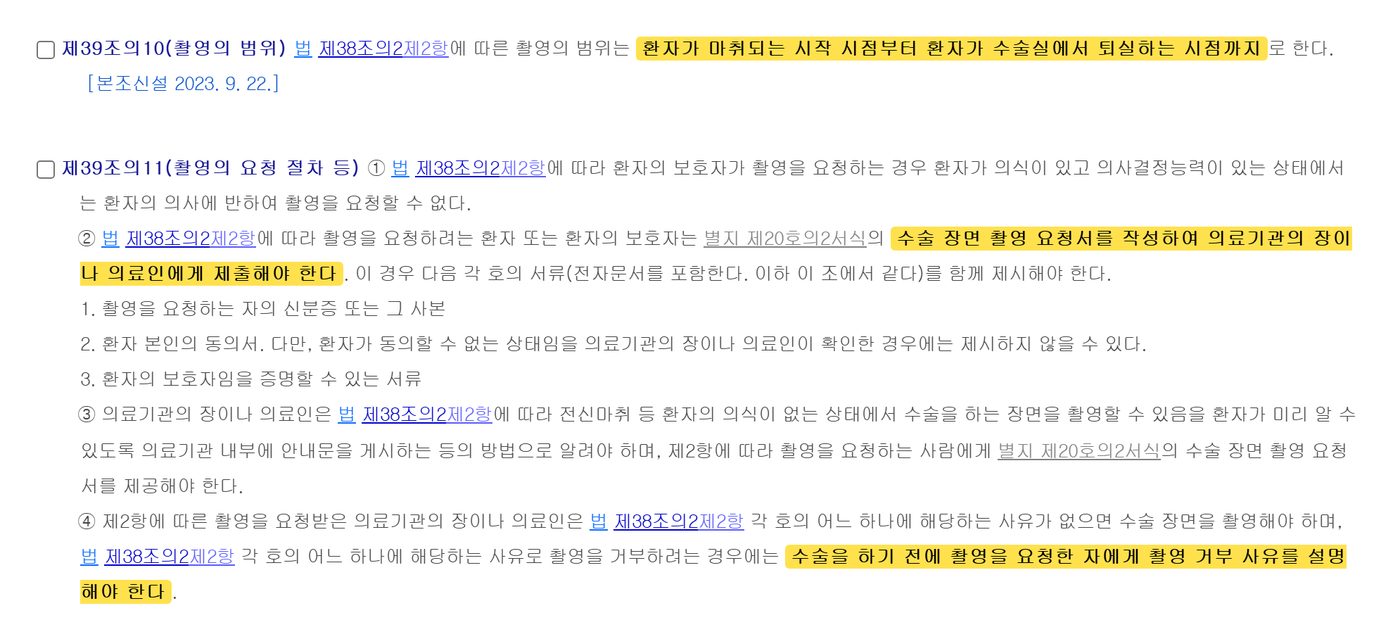
The Ministry of Health and Welfare's Enforcement Rule fills in the details:
- What is filmed: from the moment anesthesia begins until you leave the operating room (Article 39-10).
- How to ask: fill in the official form, 수술 장면 촬영 요청서 (surgery filming request form, Form No. 20-2), and submit it to the head of the clinic or the medical professional together with the requester's ID or a copy. The rule also lists the patient's own consent (unless the clinic confirms the patient cannot consent) and proof of guardianship, which matter when a guardian makes the request. A guardian cannot ask against the wishes of a patient who is conscious and able to decide (Article 39-11(1) and (2)).
- Clinics must tell patients filming is possible: for example with a notice posted inside the clinic, and they must provide the request form to anyone who asks for filming (Article 39-11(3)).
- Refusals come before surgery: a clinic that refuses for a lawful reason must explain that reason to the requester before the operation (Article 39-11(4)). It must also record each request in a log, including whether it filmed or refused, and keep the log for three years.
- Ask early: a request made at a point when filming would make it impossible to perform the surgery as scheduled is a lawful reason to refuse (Article 39-12(2)).
- Where the camera points: the installation standard (Annex 7-2) requires cameras placed so that blind spots are minimized and the patient and the medical staff taking part can be identified. Cameras must film in a fixed direction, must not be adjustable at will, and must be HD quality or better.
For ghost surgery, that last point explains why CCTV matters: the standard is written so that the people in the room can be identified.
What CCTV does not give you
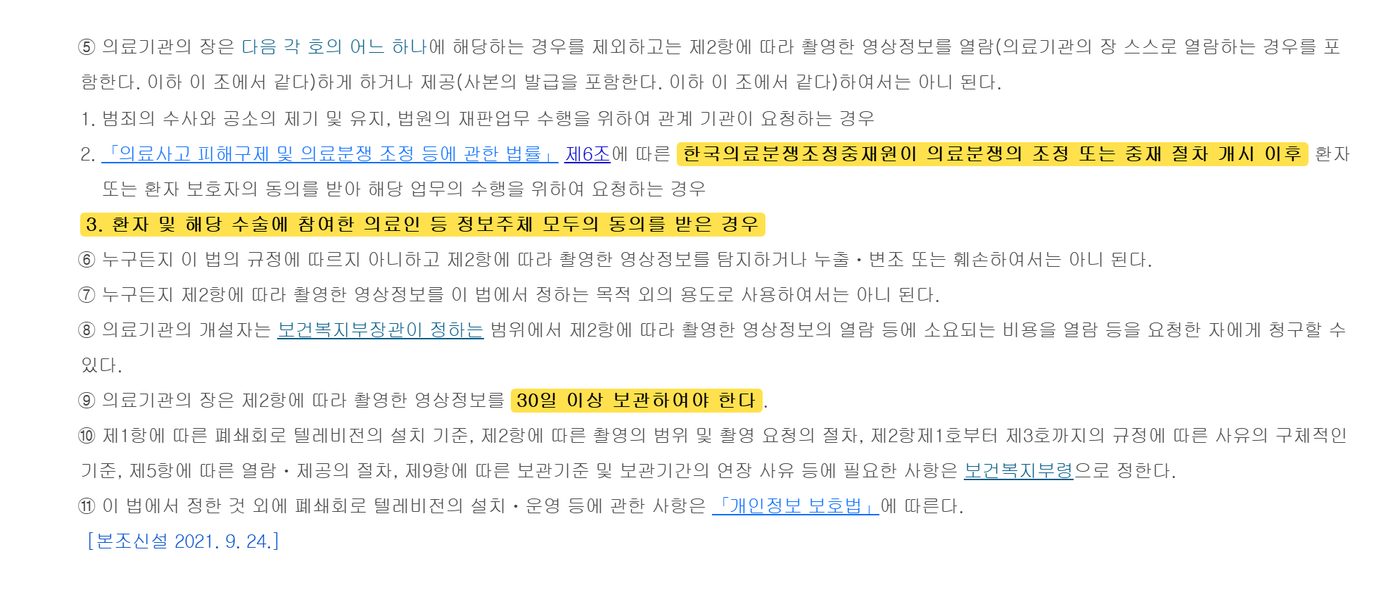
Being filmed is not the same as being able to watch the film. Paragraph 5 says the head of the clinic may not let anyone view the footage, including the head of the clinic, and may not provide it or issue a copy, except in three cases:
- A relevant agency requests it for a criminal investigation, a prosecution or court proceedings.
- The Korea Medical Dispute Mediation and Arbitration Agency requests it, with the patient's or guardian's consent, after mediation or arbitration proceedings have started.
- Everyone filmed consents, including the patient and the medical staff who took part.
In other words, a patient who simply asks to watch their own operation has no right to do so under this article, unless the medical staff who were filmed also agree or one of the other two routes applies.
Two more practical limits apply:
- Retention is only a minimum of 30 days. Under Article 39-17 of the Enforcement Rule, the clinic deletes footage older than 30 days on the cycle set in its internal management plan. It must not delete footage while a viewing or provision request under paragraph 5 is pending, or after receiving a retention-extension request with documents showing that such a procedure is being prepared. The request uses Form No. 20-5, a combined form for viewing, provision or extension. Each extension runs up to 30 days from the request and can be renewed before it ends.
- Costs and timing. Paragraph 8 lets the clinic charge the person requesting viewing for the cost, within limits set by the Minister of Health and Welfare. When a valid request arrives, the clinic must, within 10 days, tell the requester how the footage will be viewed or provided, or give its reason for refusing (Enforcement Rule, Article 39-15).
The law treats misuse seriously. Letting someone view or providing footage outside the three cases, leaking or altering it, or using it for other purposes can bring up to five years in prison or a fine of up to 50 million won (Article 87-2(2)). Filming medical acts with the operating-room CCTV without following the request procedure can bring up to three years in prison or a fine of up to 30 million won (Article 88). Failing to install the CCTV, film on request, keep audio off, protect the footage, or keep it for 30 days is punishable by a fine of up to 5 million won (Article 90).
Duty 3: only licensed medical personnel may operate (Article 27)
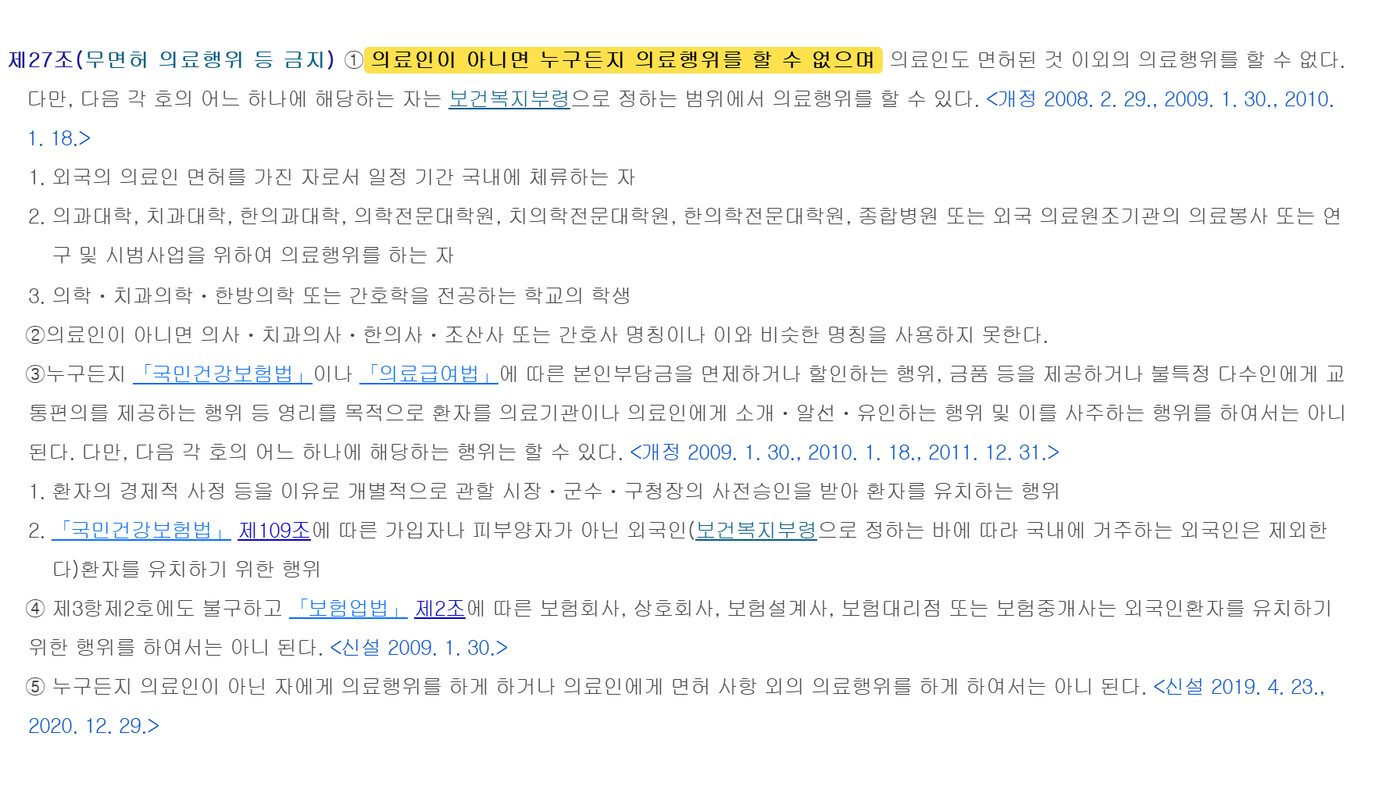
Article 27(1) says no one who is not a medical person may perform medical acts, and medical persons may not perform medical acts beyond their license. Under Article 2, "medical persons" are doctors, dentists, Korean medicine doctors, midwives and nurses licensed by the Minister of Health and Welfare. Nursing assistants (간호조무사) are not on that list.
The article allows narrow exceptions, within limits set by ministerial ordinance: holders of a foreign medical license staying in Korea for a set period, people performing medical acts for volunteer work or research at listed institutions, and students of medicine, dentistry, Korean medicine or nursing.
Paragraph 5, added in 2019, covers the other side of a substitution: no one may have a non-medical person perform medical acts, or have a medical person perform acts beyond their license. This reaches the doctor or clinic that arranges the substitution, not only the person who performs it.
Penalties, including the 2026 increase
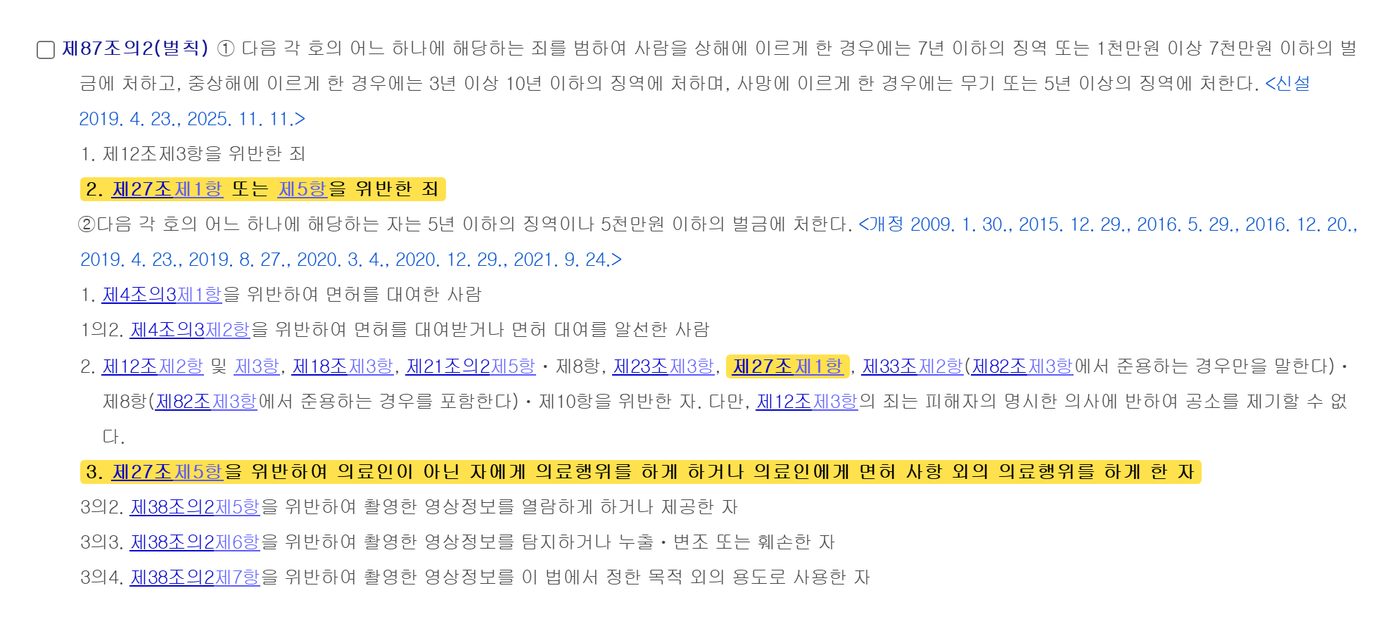
Article 87-2 sets these maximum penalties:
| Conduct | Maximum penalty under Article 87-2 |
|---|---|
| Performing medical acts without a license, or beyond one's license (Article 27(1)) | Up to 5 years in prison or a fine of up to 50 million won |
| Having a non-medical person perform medical acts, or a medical person act beyond their license (Article 27(5)) | Up to 5 years in prison or a fine of up to 50 million won |
| Either of the above, causing injury | Up to 7 years in prison, or a fine of 10 million to 70 million won |
| Either of the above, causing serious injury | 3 to 10 years in prison |
| Either of the above, causing death | Life imprisonment or at least 5 years in prison |
The injury, serious-injury and death tiers for Article 27 violations are recent. Before Act No. 21111 of November 11, 2025, paragraph 1 applied only to violating Article 12(3), which bans assaulting or threatening medical staff or patients where medical care is given. The amendment's addendum put the new paragraph 1 into force three months after promulgation, and law.go.kr lists that version as effective February 12, 2026. Its published reason, quoted above, names proxy surgery by unqualified persons.
There is also a license consequence. Under Article 65(1)7, the Minister of Health and Welfare may revoke the license of a medical person who, in violation of Article 27(5), has a non-medical person perform surgery, transfusion or general anesthesia likely to cause serious harm, or has a medical person perform it beyond their license.
A separate law can apply when unlicensed practice is a business. Article 5 of the Special Act on the Control of Public Health Crimes (보건범죄 단속에 관한 특별조치법, version effective October 1, 2025) says that a person who, in violation of Article 27 of the Medical Service Act and for profit, practices medicine as a business without being a doctor (or dentistry without being a dentist, or Korean medicine without being a Korean medicine doctor) faces life imprisonment or at least two years in prison, together with a fine of 1 million to 10 million won.
These figures are the ranges written in the statutes. What a court or the ministry imposes in an actual case is a separate question.
Duty 4: name tags, except in the operating room (Article 4(5))

Article 4(5) requires the head of a medical institution to direct and supervise medical persons, medical students performing medical acts under the Article 27 exception, nursing assistants and medical technicians so that they wear name tags inside the institution. The stated purpose is that patients and guardians can tell who is performing medical acts.
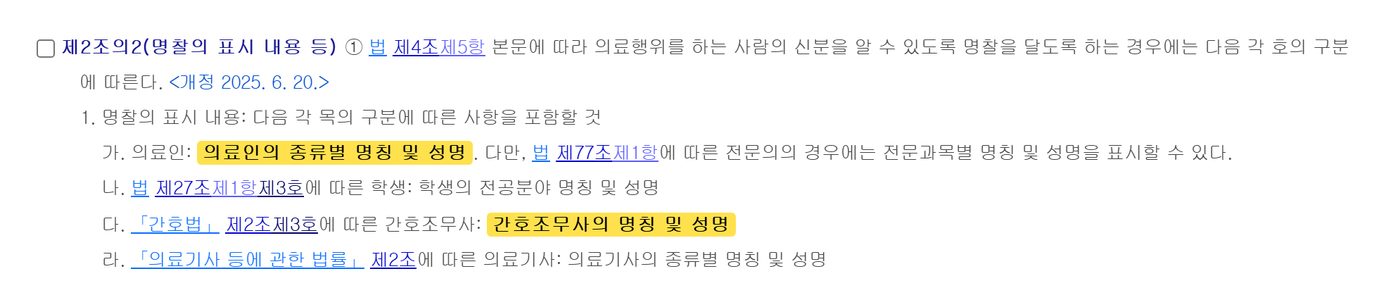
Article 2-2 of the Enforcement Decree says what the tag must show:
- Medical persons: their license type (for example, doctor or nurse) and name. Specialists may show their specialty and name instead.
- Medical students: their field of study and name.
- Nursing assistants: the title 간호조무사 (nursing assistant) and name.
- Medical technicians: their technician type and name.
The tag may be printed, engraved, attached or embroidered, and worn on clothing or around the neck.
The limit: the proviso to Article 4(5) lets clinics skip name tags in emergencies, inside the operating room, when the person is not performing medical acts, and in places the decree lists: isolation rooms, sterile treatment rooms, and similar facilities designated by the ministry to prevent hospital infections. So a name tag can help you in a consultation or treatment room, for example during an injection or laser session, but the law does not require one in the room where ghost surgery would happen. There, the consent form and CCTV are your tools.
Enforcement is also indirect. The fine for a name-tag violation, up to 1 million won, applies when a clinic head fails to follow a corrective order issued for that violation (Article 92(3)8).
Duty 5: accurate records, and your right to copies (Articles 22 and 21)
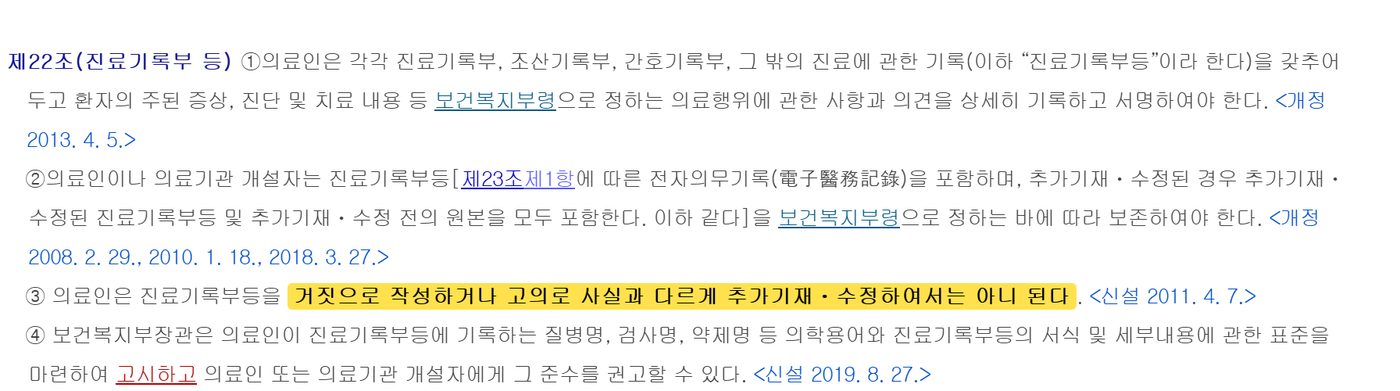
Article 22(1) requires each medical person to keep medical records and to record in detail, and sign, the matters set by ministerial ordinance, such as the patient's main symptoms, diagnosis and treatment, along with their opinion. Paragraph 2 requires the records to be preserved, including electronic records and, where records were added to or amended, both the amended version and the original. Paragraph 3 bans writing records falsely or intentionally adding to or amending them contrary to the facts.
False or altered records can bring up to three years in prison or a fine of up to 30 million won (Article 88), and the ministry may suspend the license for up to one year (Article 66(1)3). Failing to keep records under paragraphs 1 and 2 is punishable by a fine of up to 5 million won (Article 90).
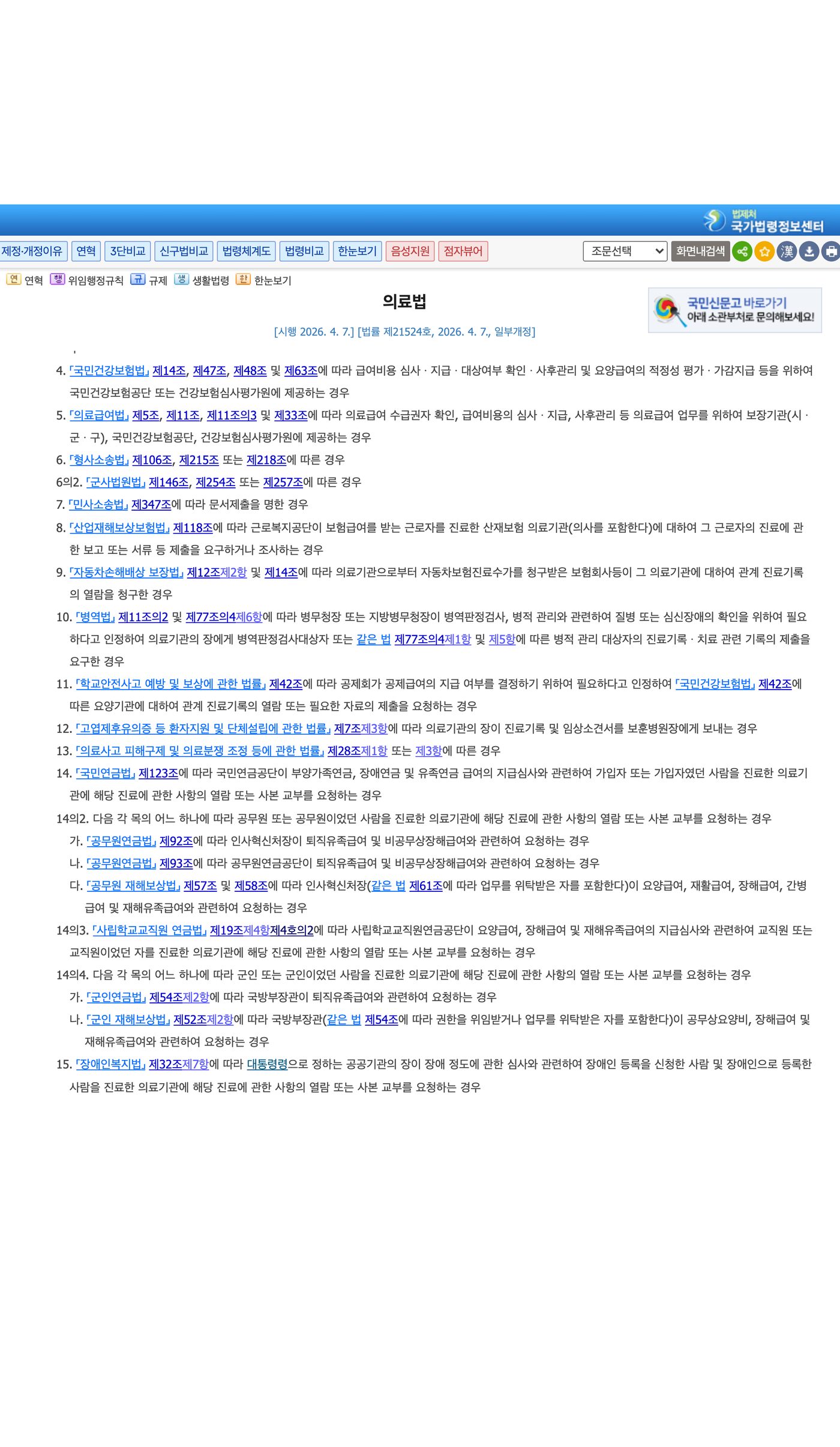
Article 21(1) gives you the right to view or get copies of all or part of your own records, including both amended records and the originals before any change. Medical persons, heads of institutions and staff must not refuse without a justifiable reason, and a refusal that breaks this rule is punishable by a fine of up to 5 million won (Article 90).
Because each medical person must sign what they record, your records are one place to look for who did what. Ask for copies before you fly home.
If something goes wrong: mediation, including from abroad
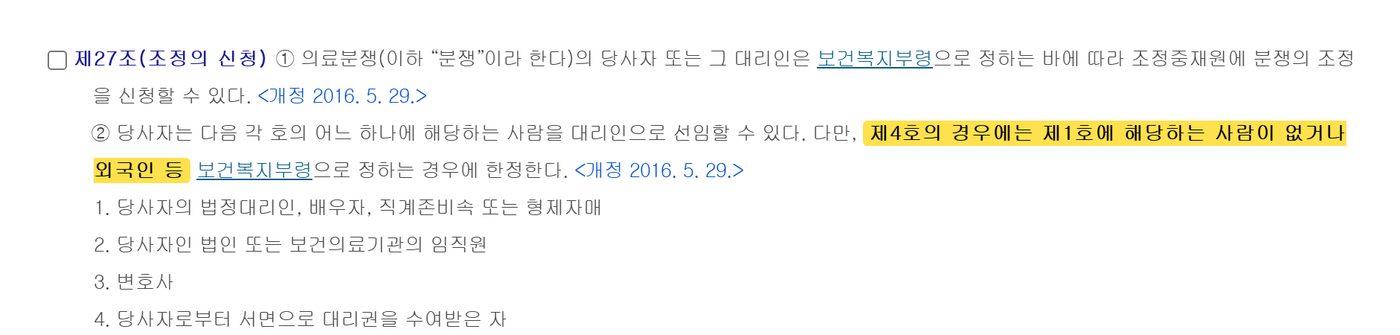
Korea's Medical Dispute Mediation Act (의료분쟁조정법) lets a party to a medical dispute, or a representative, apply for mediation to the Korea Medical Dispute Mediation and Arbitration Agency. Representatives can be a legal representative or close family member, a lawyer, or, where there is no such family member or in cases such as foreigners set by ministerial ordinance, a person the party authorizes in writing (Article 27(1) and (2)).
Under the current text, three points deserve attention:
- The other side must agree to take part. Mediation starts when the respondent, such as the clinic, tells the Agency it will participate. If it does not do so within 14 days of receiving the application, the application is dismissed (Article 27(8)). Under paragraph 9, proceedings must start without delay in cases of death, unconsciousness lasting a month or more, and certain severe disabilities.
- This connects to CCTV. The Agency's route to operating-room footage opens only after proceedings have started (Medical Service Act, Article 38-2(5), item 2).
- Deadlines. An application must be made within 10 years from the end of the act that caused the accident and within 3 years from when the injured person or their legal representative learned of the damage and who caused it (Article 27(13)).
A published amendment changes the first point. In the version effective May 27, 2027 (Act No. 21694), a respondent that does not say it refuses within 14 days will be treated as having agreed to mediation. Until that date, the current rule applies.
What the law does not do
Put together, these are the gaps a visitor should know about:
- There is no single "ghost surgery" offense. Protection comes from separate duties on consent, CCTV, licensing, name tags and records.
- The naming duty is limited. Article 24-2 covers surgery, transfusion and general anesthesia likely to cause serious harm, not every laser, filler or injection.
- A change of principal doctor requires written notice under Article 24-2. Its text does not mention fresh consent or say when the notice must be given.
- The fine for skipping consent or notice is administrative: up to 3 million won.
- Name tags are not required inside the operating room.
- CCTV films only on request, with lawful reasons to refuse, and without sound unless everyone agrees.
- Patients cannot simply watch the footage, and it only has to be kept for 30 days unless a request or extension stops deletion.
- Mediation currently needs the other side's agreement, except in the most serious cases, until the May 27, 2027 amendment takes effect.
A checklist for your procedure in Korea
Before you book
- Ask, in writing, who will perform the procedure and whether that doctor will be named as a principal doctor on the consent form.
- Ask whether you will be unconscious during the operation; the law's example is general anesthesia. If so, the clinic is covered by the operating-room CCTV rule, and you can ask for filming.
- Ask whether the clinic will give you a copy of the signed consent form.
- For injections and laser treatments, ask who will perform them and what license that person holds. The CCTV and written-consent articles may not apply, so this question does more of the work.
- If you need an interpreter, arrange one for the consultation and the consent discussion.
On the day, before anesthesia
- Read the consent form and check the names of the explaining doctor and the principal doctors (Article 24-2(2), item 3).
- Ask for a copy of the form once it is signed (Article 24-2(3)).
- Submit the filming request form (Form No. 20-2) early, with ID. Bring your passport and ask the clinic to confirm it accepts it. If the clinic refuses to film, it must explain why before the operation.
- If you also want sound recorded, ask for the separate audio request form. Audio needs everyone's consent.
- Outside the operating room, read name tags. They show the license type and name, and a nursing assistant's tag says 간호조무사.
After the procedure
- Request copies of your medical records (Article 21(1)), and keep the consent form and any written notice of change together.
- Check whether you received written notice of any change in the principal doctor or the method (Article 24-2(4)).
- If you have concerns about what happened in the operating room, keep the 30-day minimum in mind. A retention-extension request (Form No. 20-5) needs documents showing that a procedure under Article 38-2(5) is being prepared, so seek advice early.
- For disputes, consider mediation through the Korea Medical Dispute Mediation and Arbitration Agency. The Act allows a representative authorized in writing in cases such as foreigners. For advice on your own case, talk to a lawyer licensed in Korea.
For product questions about injections, see our guide to Korean botulinum toxin brands in the MFDS database.
Frequently asked questions
Q. What is ghost surgery in Korea?
It is the practice of a doctor other than the one the patient chose, or a person who is not a licensed medical professional, performing an operation, usually while the patient is unconscious. The literal Korean is 유령수술, and official documents use 대리수술 (proxy surgery). Neither term appears in the articles of the Medical Service Act. The law addresses it through consent rules (Article 24-2), operating-room CCTV (Article 38-2), the ban on unlicensed medical acts (Article 27), name tags (Article 4(5)) and record rules (Articles 21 and 22).
Q. Does a Korean clinic have to tell me who will perform my surgery?
For surgery, blood transfusion or general anesthesia that is likely to cause serious harm, yes. Article 24-2 requires a written consent that includes the names of the explaining doctor and the principal doctors taking part. If the principal doctor changes, the clinic must tell you the reason and content in writing. Failing to do either can bring an administrative fine of up to 3 million won under Article 92.
Q. Can I ask a Korean clinic to film my surgery?
Yes, if your operation will be performed while you are unconscious, such as under general anesthesia. Article 38-2 requires clinics that perform such surgery to install CCTV in the operating room and to film it when the patient or guardian asks, unless a listed reason applies, such as emergency or high-risk surgery. Under the Enforcement Rule, you submit Form No. 20-2 with ID, and any refusal must be explained before the operation.
Q. Can I get the CCTV footage of my operation?
Not simply by asking. Article 38-2(5) allows viewing or copies only when an agency requests them for an investigation or court case, when the Korea Medical Dispute Mediation and Arbitration Agency requests them with your consent after proceedings start, or when everyone filmed consents, including the medical staff. Footage must be kept for at least 30 days.
Q. Do these protections apply to Botox, fillers or laser treatments?
Partly. The rules that only licensed medical personnel may perform medical acts, that staff performing medical acts wear name tags, and that records are kept and shown to you apply to all medical acts. The written-consent duty in Article 24-2 is tied to surgery, transfusion and general anesthesia likely to cause serious harm, and the CCTV rule is tied to surgery on unconscious patients, so they may not apply to a typical injection or laser session.
Q. What are the penalties for proxy surgery in Korea?
Performing medical acts without a license, or having an unlicensed person perform them, carries up to 5 years in prison or a fine of up to 50 million won under Article 87-2. Since February 12, 2026, if either causes injury, the maximum rises to 7 years in prison or a fine of 10 million to 70 million won, and higher tiers apply to serious injury and death. A licensed medical professional who has an unlicensed person perform surgery, transfusion or general anesthesia likely to cause serious harm may also have their license revoked under Article 65. Separately, unlicensed medical practice run as a business for profit carries life imprisonment or at least 2 years in prison under Article 5 of the Special Act on the Control of Public Health Crimes.
Q. How long do Korean clinics keep operating-room footage?
At least 30 days under Article 38-2(9). Under the Enforcement Rule, footage older than 30 days is deleted on the clinic's internal schedule, unless a valid viewing request is pending or a retention-extension request has been filed with supporting documents. Each extension lasts up to 30 days and can be renewed.
Sources we checked
Every statute on this page was read on law.go.kr on September 14, 2026. The new screenshots were captured from these pages, and the reused screenshots were checked against the current wording.
- Medical Service Act (의료법), version effective September 11, 2026 (Act No. 21423): Articles 2, 4(5), 12(3), 21(1), 22, 24-2, 27, 38-2, 65(1), 66(1), 87-2, 88, 88-2, 90 and 92
- Medical Service Act, version effective April 7, 2026: source of the Article 24-2 screenshot; the wording matches the September 11, 2026 version
- Medical Service Act, version effective February 12, 2026 (Act No. 21111, amended November 11, 2025): Article 87-2(1), its addendum and the published reason for the amendment
- Medical Service Act, version effective September 25, 2023 (Act No. 18468, amended September 24, 2021): Article 38-2, its addendum and the published reason for the amendment
- Enforcement Decree of the Medical Service Act, version effective February 10, 2026: Articles 2-2 and 10-13
- Enforcement Rule of the Medical Service Act, version effective June 12, 2026: Articles 39-9 to 39-17, Annex 7-2, and Forms No. 20-2 and 20-5
- Special Act on the Control of Public Health Crimes (보건범죄 단속에 관한 특별조치법), version effective October 1, 2025 (Act No. 21065): Article 5
- Act on Remedies for Injuries from Medical Accidents and Mediation of Medical Disputes (의료분쟁조정법), version effective June 21, 2025: Article 27; and the version effective May 27, 2027 (Act No. 21694) for the change to Article 27(8)
We describe the statutes, not how courts have applied them in particular cases. For how we research, see our method.